

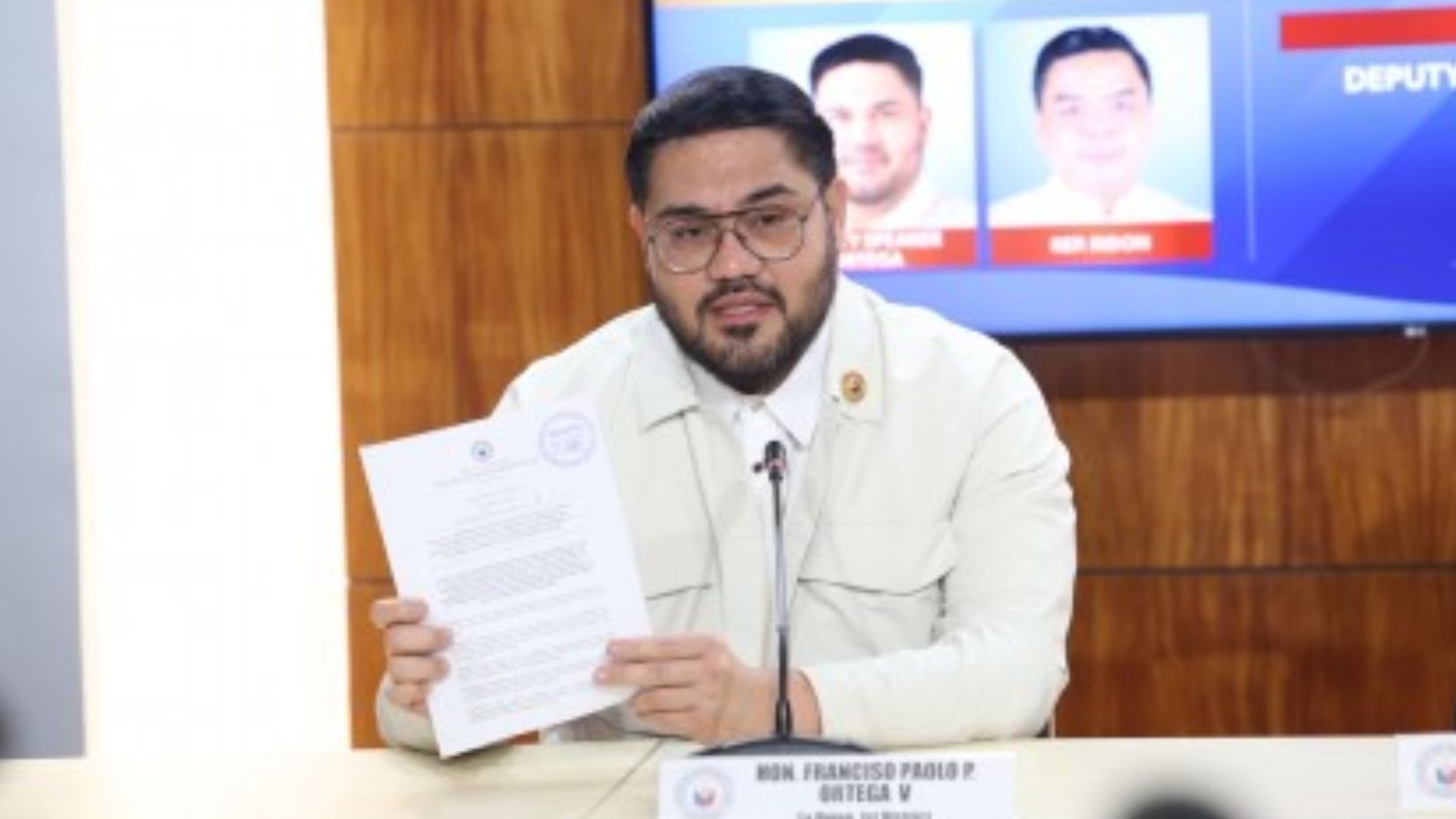






Deputy Speaker Francisco Paolo Ortega V has joined legislators across party lines in endorsing a bill declaring that the battle to protect women from discrimination and violence in the political sphere transcends every divide and belongs to the entire nation.
House Bill No. 8393, or the Prevention of Violence Against Women in Politics (VAWP) Act, was filed by House Senior Deputy Minority Leader and Mamamayang Liberal Party-list Rep. Leila de Lima and 41 other lawmakers at the House of Representatives on Tuesday.
In a statement on Wednesday, Ortega stressed that VAWP is not solely a women’s issue, nor is it confined to any single political camp.
“When a woman is attacked, threatened, shamed, or driven out of politics because of her gender, it is not just her voice that is silenced – it is our democracy that is weakened,” he said.
“Every Filipino has a stake in making politics safe and inclusive. Ending VAWP opens the door for fresh, independent, non-dynastic leaders, reduces the grip of systemic corruption, and accelerates national progress through the full and fearless participation of women in governance.”
He called on Congress, all political parties, digital platforms, civil society organizations, and ordinary citizens to stand united behind the bill.
“This is not about left or right, administration or opposition. This is about right and wrong. Protecting women in politics protects the future of our country—and that is everyone’s responsibility,” Ortega said.
HB 8393 defines and criminalizes Violence Against Women in Politics and Gender-Based Political Violence (GBPV) as distinct, politically motivated offenses.
It targets the full spectrum of abuse – physical attacks, sexual harassment, psychological torment, economic sabotage, institutional exclusion, symbolic degradation, and especially the rapidly evolving forms of technology-facilitated violence including gendered disinformation, deepfakes, doxxing, slut-shaming, coordinated online harassment, and brigading — that are weaponized to silence, shame, intimidate, or permanently exclude women from political life.
The persistent threat of VAWP continues to deter countless capable women, particularly those from marginalized communities, including young leaders, indigenous women, LGBTQIA+ individuals, persons with disabilities, and solo parents, whose vulnerabilities are often compounded by intersecting forms of bias and exclusion.
The proposed law treats VAWP as a serious assault on democratic participation. When committed during electoral processes, such acts are classified as election offenses punishable by one to six years of imprisonment without probation, disqualification from holding public office, and loss of the right to vote. (PNA)