

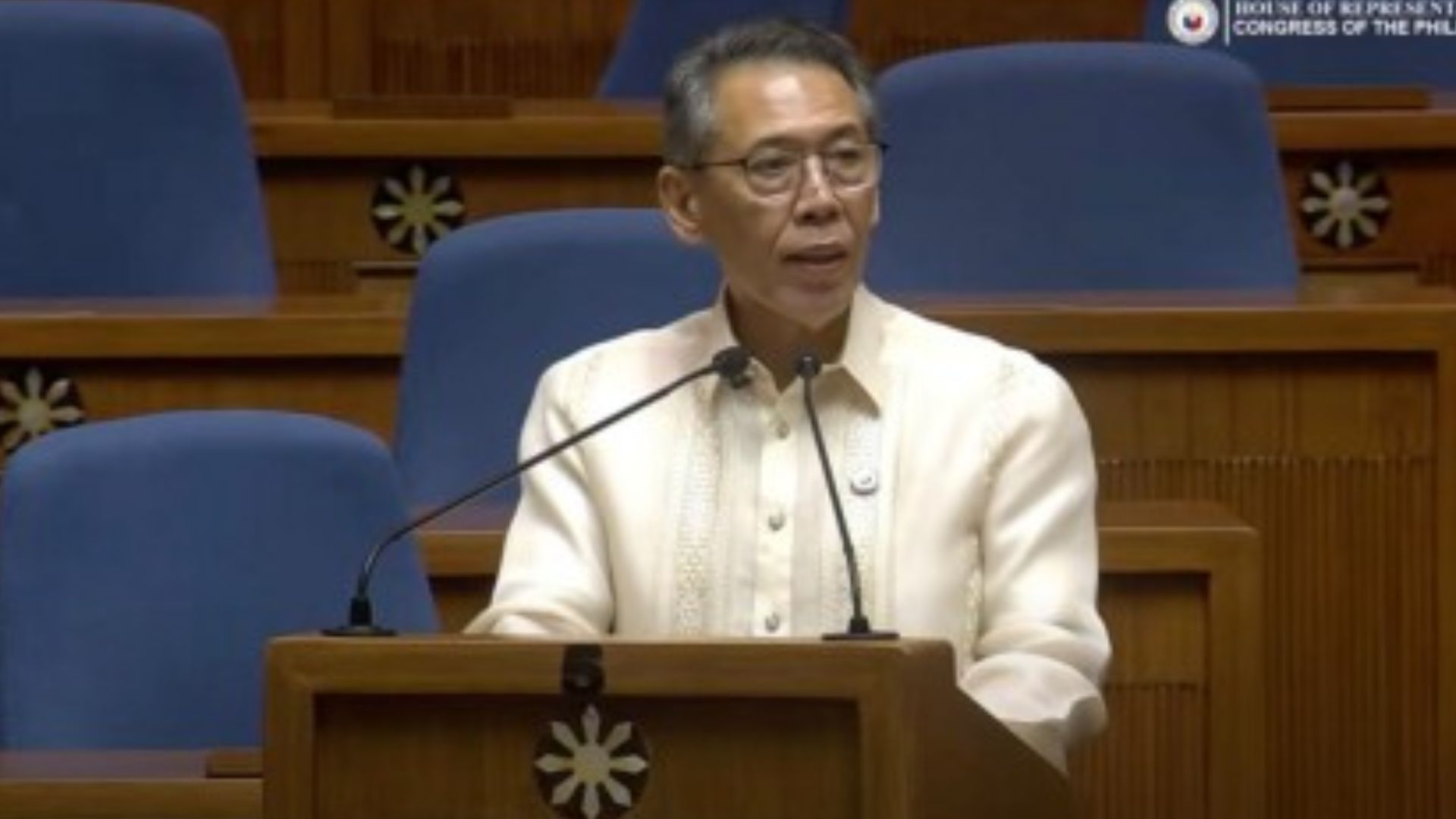







House prosecutor Rep. Chel Diokno on Wednesday urged the Senate sitting as an impeachment court to fully exercise the constitutional powers vested in it, stressing that the issue extends beyond the subpoena of bank records, tax records and Anti-Money Laundering Council (AMLC) reports.
During the oral arguments on the prosecution’s request for subpoenas on Vice President Sara Duterte’s bank and tax records, Diokno stressed that the Constitution itself grants the impeachment court extraordinary authority to determine whether the country’s highest public officials remain fit to continue in office.
“The Constitution vests this Impeachment Court with extraordinary powers,” Diokno said.
He emphasized that this authority comes directly from the Constitution and cannot be diminished by ordinary laws or administrative rules.
“Because this power comes directly from the Constitution, no one — no person, no law, and no administrative rule — can limit or supersede it,” he said.
Diokno warned that adopting the defense’s position would have consequences far beyond the present motion for subpoenas.
“I repeat: no one can handcuff this Court’s power to try and decide this impeachment case,” Diokno said.
He explained that the Senate, sitting as an impeachment court, alone has the constitutional authority to determine what evidence is necessary to resolve the issues before it.
“Kayo lang po, Your Honors, ang may kapangyarihan magpasya kung ano ang impeachable offense at kung anong ebidensya ang maaaring tanggapin para patunayan ito (Only you, your honors, have the power to decide on what constitutes an impeachable offense and what evidence to accept to prove it),” he said.
Citing Supreme Court (SC) jurisprudence, Diokno argued that determining what constitutes an impeachable offense is a political question entrusted by the Constitution to the Legislature.
“Since this Impeachment Court has the sole power to determine what constitutes an impeachable offense, no one – not the Supreme Court, much less the defense – can impose limitations on that power. No one can dictate to this Impeachment Court how to exercise the exclusive power to decide what constitutes an impeachable offense.”
Diokno said the prosecution’s request for subpoenas is anchored on the court’s constitutional duty to decide the case based on a complete factual record.
He underscored that the prosecution’s objective is for the truth to come out so that the impeachment court may decide the case “based on the truth, the whole truth, and nothing but the truth.”
Search For Truth In Impeachment
Diokno told the impeachment court that the confidentiality provisions of the Anti-Money Laundering Act (AMLA) should not be interpreted to prevent the Court from obtaining AMLC records relevant to the impeachment proceedings.
He explained that the confidentiality provisions under the AMLA were enacted to protect the integrity of money laundering investigations, not to prevent a constitutionally created impeachment court from performing its duty.
“While the law does contain a confidentiality clause, it was designed to prevent AMLC officials from leaking information to persons who are the subject of CTRs (currency transaction reports) and STRs (suspicious transaction reports) and preserve the integrity of investigations,” he said.
“It was not designed to short-circuit impeachment proceedings or prevent the Impeachment Court from ascertaining the truth,” he added.
Impeachment As Exception
Diokno also clarified that the Bank Secrecy Law itself recognizes impeachment proceedings as an exception to the confidentiality of bank deposits, rejecting the claim that the requested bank records are beyond the reach of the impeachment court.
Quoting Republic Act 1405, Diokno pointed to the law’s express language: “All deposits are hereby considered as of an absolutely confidential nature except in cases of impeachment.’”
“Walang kaduda-duda. May karapatan at kapangyarihan ang Impeachment Court na busisiin ang bank records ni VP Sara (There’s no room for doubt. The Impeachment Court has the right to examine the bank records of VP Sara),” he pointed out.
Diokno also emphasized that the Data Privacy Act does not bar the issuance of subpoenas in impeachment proceedings, noting that the law itself recognizes disclosure of personal information when it is needed pursuant to a subpoena duly issued.
“The law itself affirms that confidentiality shall not apply… should the personal information be needed pursuant to a subpoena duly issued.”
Diokno stressed that the prosecution is asking the Court to exercise powers that the Constitution and the law already recognize.
He concluded by reminding the Court that impeachment proceedings are ultimately governed by the Constitution’s principle of public accountability.
“Kaya naman po, ang hiling namin sa Korte: Gamitin ang inyong natatanging karapatan at kapangyarihan na busisiin ang bank records, tax records, at AMLC reports. Sa ganitong paraan, madedesisyunan ninyo ang kaso base sa buong katotohanan — the truth, the whole truth, and nothing but the truth — para sa interes at kapakanan ng sambayanang Pilipino (That’s why we ask the court: Use your exclusive rights and powers to examine the bank records, tax records and AMLC reports. In this way, you can decide the case on the basis of the whole truth – the truth, the whole truth, and nothing but the truth – in the interest and welfare of the Filipino people),” Diokno said.
No Fishing Expedition
Meanwhile, Diokno said a Supreme Court ruling has already rejected the argument that subpoenas for bank records in an unexplained wealth case amount to a fishing expedition, undermining the defense’s attempt to keep the financial records of Duterte and her husband from being produced in her impeachment trial.
Diokno invoked the 2022 ruling in Republic v. Rabusa as he rebutted objections to the prosecution’s request for subpoenas covering the couple’s bank records, tax documents and Anti-Money Laundering Council reports.
“Paulit-ulit din po nilang sinasabi na ang ginagawa po ng prosecution ay ‘fishing expedition.’ Actually po, mayroon nang desisyon ang (The defense repeatedly states that what the prosecution is doing is a fishing expedition. The is already a decision of the) Supreme Court that addresses squarely this point,” Diokno stressed.
The case involved a government forfeiture action seeking to recover wealth allegedly accumulated by former military comptroller George Rabusa beyond his lawful earnings, with the Supreme Court eventually ordering the trial court to consider evidence obtained from the questioned bank accounts.
“Just like here, the prosecution in that case requested subpoenas for the production of bank records. Just like here, the argument was raised that this is a mere fishing expedition,” Diokno pointed out.
Quoting the ruling, he recounted that the lower courts had initially treated the request to examine the accounts as an arbitrary attempt to search for evidence, but the Supreme Court held that proceedings involving unexplained wealth fell within the statutory exceptions to bank secrecy.
“As the present proceedings on unexplained wealth are now encompassed within the exceptions of Republic Act 1405 (Bank Secrecy Law), the court orders subject of this case clearly fall within the orders that would enable the examination of the respondents’ bank accounts, as contemplated in the first exception,” Diokno quoted from the decision.
“Given the existence and propriety of the subpoenas, the evidence procured through the same should have been duly considered by the lower courts. This court cannot agree with the Court of Appeals’ supposition that the examination of the respondents’ bank accounts was but a mere fishing expedition to pin liability on them,” he continued.
Diokno separately rejected the claim that the issuance of subpoenas would violate Duterte’s right to due process, explaining that the prosecution was merely asking the Senate Impeachment Court to order the production of documents that had yet to be identified by witnesses or formally offered as evidence.
“First of all, we are not yet at the stage where any evidence is being put in the trial or offered to the honorable court. Nandito pa lang po tayo sa punto na kung maaari bang ipa-produce natin itong mga dokumentong ito (we are still at the point where we would want to produce these documents),” he explained.
“The defense will have every opportunity to make objections, if and when, particular exhibits or documents are identified by a witness and offered in evidence. Therefore, wala pong due process violation ang pag-issue ng subpoena (the issuance of a subpoena is no violation of due process),” Diokno maintained.
The requested records relate to the prosecution’s allegations that VP Duterte accumulated unexplained wealth disproportionate to her lawful income, omitted assets from her Statements of Assets, Liabilities and Net Worth and engaged directly or indirectly in business while holding public office.
Diokno stressed that confidentiality laws should not be invoked prematurely to prevent the senator-judges from obtaining records that may ultimately confirm or disprove the allegations.
“Your Honors, madaling sabihin na confidential ang ilang impormasyon at dokumento. Madaling magturo ng batas. Pero ang hinahanap po ng Impeachment Court ngayon at sa mga susunod na araw, linggo at buwan ay ang katotohanan, at ang layunin ay makamit ang pananagutan (it is easy to say that the information is confidential. It is easy to point to certain laws. But what the Impeachment Court is searching now and in the following days and months is the truth, and the objective is to attain accountability)” he stressed.
“Confidentiality, Your Honor, should not be the prevailing principle in this proceeding. Hindi po confidential ang katotohanan (Confidentiality is not the truth),” Diokno added. (PNA)