

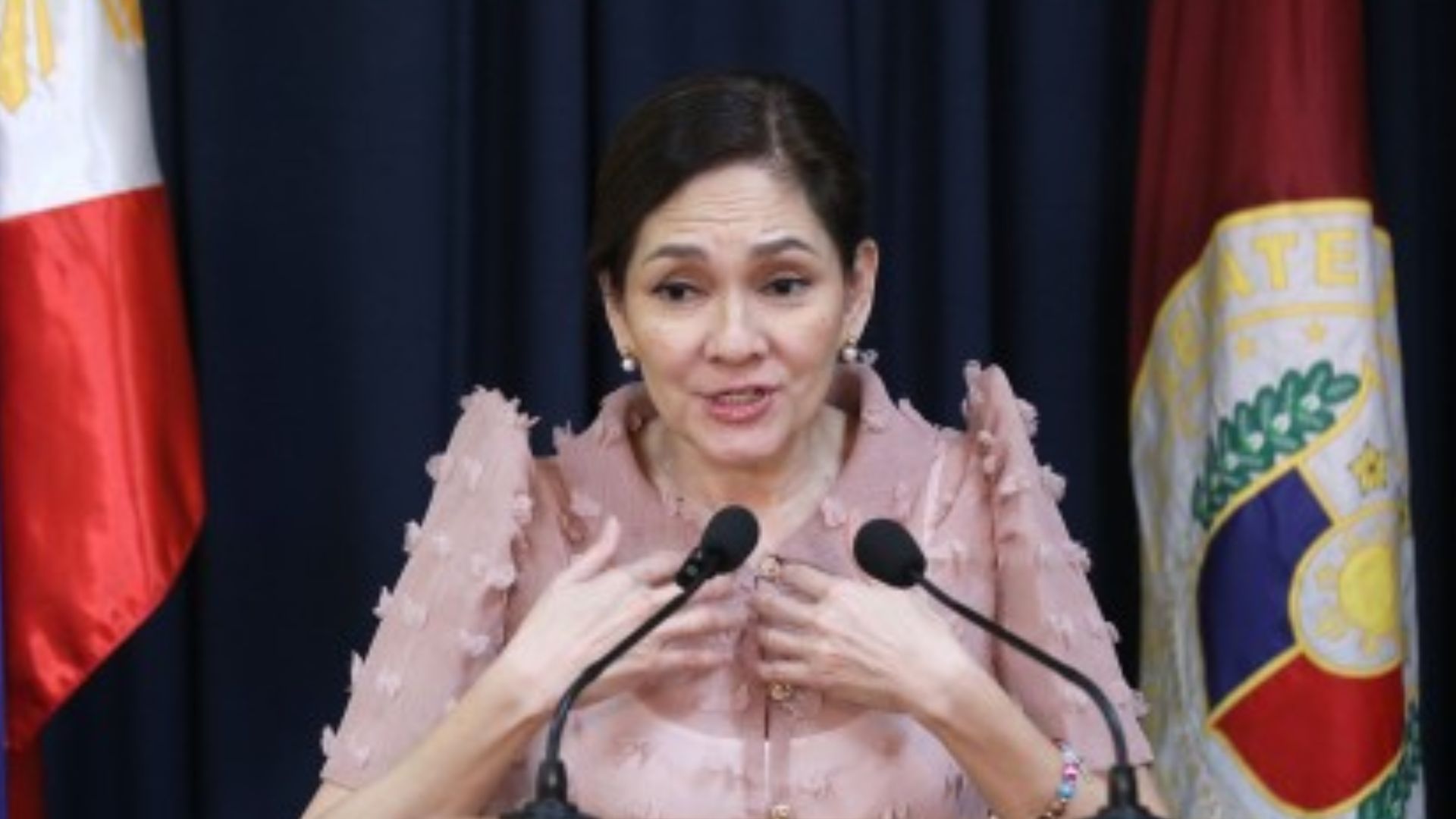







A Senate committee on Tuesday endorsed a consolidated bill prohibiting relatives up to the second degree of consanguinity or affinity from simultaneously holding national or local elective posts.
Senate Committee on Electoral Reforms and People’s Participation Committee chairperson Risa Hontiveros said the proposed coverage includes parents, children, siblings, and spouses.
Hontiveros said the second-degree prohibition is a practical “first step” toward reform.
She said the measure seeks to finally implement the 1987 Constitution’s directive to prohibit political dynasties as may be defined by law.
“The 1987 Constitution declares that the State shall guarantee equal access to opportunities for public service and prohibit political dynasties as may be defined by law… and yet, for nearly forty years, that constitutional command has remained unfulfilled,” she said in her sponsorship speech.
Committee Report No. 33 recommends approval of Senate Bill No. 1901, titled “An Act Prohibiting Political Dynasties in National and Local Elective Offices and Party-Lists, and Providing Penalties Therefor”.
The bill bars both simultaneous and successive holding of elective posts within the same jurisdiction, including party-list participation.
“Dine-define namin sa committee report ang political dynasty bill hanggang sa second degree of consanguinity and affinity (We define in the committee report the political dynasty bill up to the second degree of consanguinity and affinity),” Hontiveros said.
She acknowledged that earlier proposals covered up to the third or fourth degree, including her own bill, but said enforceability was a key consideration.
“We listened to the Commission on Elections… enforceability is essential. That is why this bill limits the prohibition to relatives within the second degree,” she said.
The measure requires candidates and party-list nominees to submit sworn certifications declaring that no prohibited political dynasty relationship exists.
It authorizes the Commission on Elections to deny or cancel certificates of candidacy upon verified violation and provides for criminal penalties under the Omnibus Election Code.
Hontiveros argued that entrenched political dynasties are linked to weaker development outcomes.
“Studies… have consistently shown a correlation between entrenched dynasties and higher poverty incidence, weaker human development outcomes, and slower local economic growth,” she said.
She described the bill as both principled and practical.
“Hindi ito perpekto. Ngunit ito ay posible. At ito ay makabuluhan (It is not perfect. But it is possible. And it is meaningful),” she said.
“Then again, foundation siya for future amendment (Then again, it will serve as a foundation for future amendment).”
The bill will take effect beginning in the next succeeding elections, allowing incumbents to complete their terms as provided under the transitory clause.
Meanwhile, Senate President Vicente Sotto III expressed openness to the second-degree limitation, describing it as the original and more realistic proposal.
“Puwede, okay. ‘Yun naman talaga ang original na suggestion, 2nd degree of consanguinity (That is actually the original suggestion, second degree of consanguinity),” Sotto said.
“Siguro. Mas madali ‘yun (Perhaps. That would be easier),” he added.
Senator JV Ejercito co-sponsored the measure in the plenary, describing the day as “historic” and long overdue.
Citing data from the Philippine Center for Investigative Journalism, Ejercito noted that 71 out of 82 provincial governments remain under political families and that at least 18 provinces are considered to have “obese” dynasties where five or more relatives hold office simultaneously.
“When public office becomes a family heirloom, the ‘public’ part of the office begins to disappear,” he said.
Ejercito said the bill seeks to democratize public service and ensure that no family monopolizes political power.
“Walang sinumang pamilya ang dapat na mag monopolyo ng kapangyarihan (No family should monopolize power),” he said. (PNA)